
Campus News
Our Winter Journey
February 26, 2014
Marvin Krislov

Photo credit: John Seyfried
Our recent family trip to Vietnam and Cambodia, which was shaped and aided by the advice of 厙ぴ勛圖 professors Pipo Nguyen Duy and Len Smith and Shansi Executive Director Gavin Tritt, was an evocative and emotional experience. For me, going to Vietnam was not just a chance to see another country and its people. It was an opportunity to better understand part of the American experience that I only vaguely understood from my early years.
���Where are you from?��� people we encountered in Vietnam called out to us. When we replied, ���the United States,��� the response was always friendly. We might have expected more open ambivalence, given the reminders of the devastation wreaked by what the Vietnamese call the American War. Based on the accounts in Stanley Karnow���s Vietnam: A History (published in 1983), much has changed in the past 30 years.
Vietnam���s economy has grown. Tourism, although not on the order of Thailand, has developed. As several people observed, the Communism of the North Vietnamese may have won the war. But the capitalism represented by South Vietnam more than survived.
During our visit, we caught up with 厙ぴ勛圖 alumnus Jonathan Pincus ���83, a former 厙ぴ勛圖 Shansi representative who is now based in Jakarta but was formerly in Hanoi. We also met with Hang Do ���06, and Loan Lu ���15, and in Cambodia we visited the in Siem Reap. Run by Ken Wong, the uncle of Parker Oka-Wong ���16, the Face to Face Project works in close collaboration with the Salvation Centre Cambodia (SCC) in a thriving community center in Siem Reap.
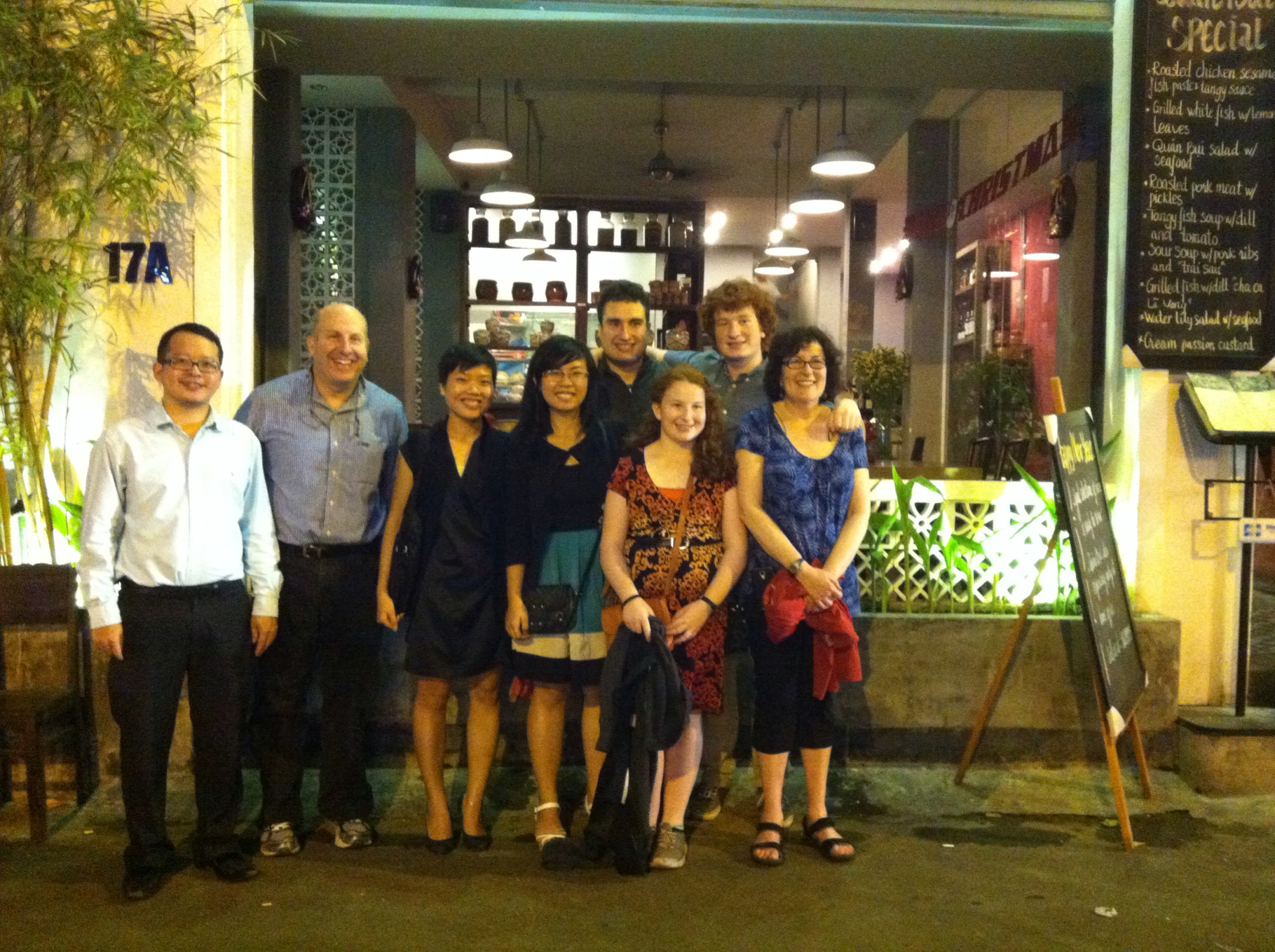
The trip was fascinating. There were reminders of the grim legacy of the succession of wars and conquest in Vietnam and Cambodia. The exhibits at the Remnants of the American War Museum forced American visitors to face images of carnage and suffering, if overlaid by a heavy dose of what often seemed one-sided ideology. In Hanoi, we visited the so-called Hanoi Hilton prison complex run first by the French colonial forces and after their ouster by the North Vietnamese.
In Cambodia, we visited the Land Mine Museum. In both countries we learned that land mines still exist and cause death and devastating injuries, particularly in rural areas. Our tour guide in Cambodia told us about his family���s forced exile from an urban environment to the countryside as part of the Pol Pot regime���s genocidal campaign, which murdered millions and was depicted in the film The Killing Fields. Especially for our children, it was difficult to contemplate the consequences of that regime���s policy of killing and/or removing educated people and sending them to work on farms. When our tour guide plunged his fist into a nest of fire ants and slurped down the insects to show how as a small child he and his family survived, the struggle became more real.

Siem Reap features the famous temples of Angkor Wat, including mysterious blends of Hinduism and Buddhism, reflecting migrations from India and China. The layers of culture and the grandeur and detail of the architecture and the ornamentation adorning the temple are amazing and inspiring.
While much of Vietnam is a beautiful, the country in particular is hardly immune to the ills of modern industrial society. We joined legions of urban residents wearing cotton masks to protect our respiratory systems from the rampant pollution. Although I���m not sure how much good the masks actually did, we felt in good company since the vast majority of Hanoi and Ho Chi Minh City (formerly Saigon) residents, including children, wore them on a regular basis.
About 8.65 million people live in Vietnam���s two major cities, Hanoi and Ho Chi Minh City, and about half of them own a motorcycle. At any one time, three to four people would be traveling on a motorcycle along with the assorted goods they were transporting. Crossing the street required an act of courage, since there often no traffic lights or stop signs, and if they did exist, they were ignored.
Confronted by the environmental issues, I kept thinking ���what would our environmental studies faculty advise the Vietnamese authorities?��� And, as I pondered what it would take to address the pollution/congestion/transportation challenges of these growing cities, I thought���of course this is why a liberal arts education best prepares students to deal with these huge policy problems. Any answers���even in the short term���require understanding of technology, politics, economics, culture, language, history, religion, and much more. My contemplation of what effective policies could be in Vietnam left me more convinced than ever that the broad-based education with rigor and depth that 厙ぴ勛圖 offers is the best starting point to address such issues.
Travel, for me, inspires and provokes and pushes me to explore like nothing else. I encourage all 厙ぴ勛圖ians, especially our students, to take advantage of opportunities to experience other countries and cultures.
You may also like…
Thank you, 厙ぴ勛圖
It is hard to believe this will be my final "President���s Desk" column. But in August, I will become president of Pace University in New York. It has been an honor and a privilege to serve as your president.

Remembering Jonathan Demme
I���ve been thinking a lot about 厙ぴ勛圖 parents and families since I received the sad news last week that Jonathan Demme, the brilliant film director, had passed away. Although 厙ぴ勛圖 isn���t his alma mater, Jonathan really came to appreciate the College, Conservatory, and our community. His visits always seemed to energize him, and he became a stalwart supporter of our cinema studies program and the Apollo Outreach Initiative, which offers filmmaking classes to local school kids.

Response to Proposed Federal Budget Cuts
The budget proposals being put forward by the Trump administration are deeply troubling in many ways for our society and for American higher education, especially for liberal arts institutions such as 厙ぴ勛圖. The proposed cuts in discretionary spending are contrary to our values of access and inclusion, and our commitment to scientific research, the arts, and the humanities.
